
People tend to miss the signs of codependency in a relationship, either because they don’t want to change the dynamic they have or because they are genuinely oblivious. People in a codependent relationship often share a lot of chemistry, intimacy, and history, and fit together as effortlessly and perfectly as puzzle pieces. The dynamics that feel so cozy are also what keep both people locked into an unhealthy relationship unless confronted.
Codependency can be an obviously toxic dynamic, where a dominant person controls and manipulates a subordinate, who, in turn, victimizes themselves into helplessness. Codependency can also be a lot more subtle and feel a lot more wholesome. Two friends might develop enmeshed identities after knowing each other and living together for so long. One cannot function without the other, and every other relationship threatens to change the dynamic between them.
There are a few signs of codependency you can notice in any relationship, regardless of its nature. Noticing only one or two might suggest that you are only beginning to develop a codependent dynamic. If you can check all three of these most basic signs of codependency, you might want to reach out to a mental health professional for help before you get locked in further.
Common Signs of Codependency
One of the first, most obvious signs of codependency in any relationship is how hyperaware you feel of each other’s emotions. On the surface, this looks like concern and sensitivity. You notice when they’re upset, and their mood affects you. Some people would call this intuition, or hypersensitivity, but when your mood hinges on their mood, and vice versa, it is one of the sure signs of codependency.
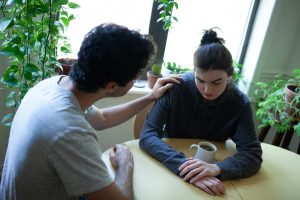 Sometimes you can’t help but mirror the feelings of the person you care for most, and you should care about their emotions. On the other hand, if you can’t find peace whenever they’re upset, and you do everything in your power to make them better, it will only end in emotional destruction for you. This type of people-pleasing behavior prioritizes their happiness over your boundaries and preferences, and it is deeply unhealthy.
People who do this in relationships ultimately come to feel responsible for the other person’s happiness or mental well-being. A child in a codependent relationship with their parent might feel the pressure of maintaining good grades or being on perfect behavior rather than risk upsetting their parents. A codependent wife might limit the amount of time she spends with her friends or practicing her hobbies for fear that her husband will feel neglected.
One of the most certain signs of codependency is feeling responsible for someone else’s happiness. Your behavior certainly can affect your loved ones, and to a degree, it is a good thing to remember. It is not something you should constantly worry about or try to interfere with, however.
The degree to which you try to control, manage, or manipulate your loved one’s well-being is the degree to which you are codependent with them. If you are honest with yourself, deep down, it feels good that they depend on you to feel better, more balanced, or more regulated. This shows that you have inserted yourself into their life in a dominant way, though.
One of the most common signs of codependency is also one of the most overlooked. If you are in a codependent relationship with someone, it feels next to impossible to set boundaries. Boundaries feel like a threat to the codependent couple. A boundary can be a literal closed door, or a figurative one. It can be a declined invitation, a stated preference, or an issue that needs to be confronted. It is a protective measure that ensures your personal peace and well-being.
The point of a boundary is that it is meant to keep other people out. It’s a red flag if it feels like you can’t or shouldn’t place a boundary between you and your loved one. Even a spousal relationship should allow for personal space and individual preferences. Do not allow codependency to rob you of a healthy, vibrant connection with someone you love.
Do You Want to Learn More?
If you are concerned that you might be participating in a codependent relationship and you want to address it, we suggest that you speak with a counselor. They will offer their perspective and help you formulate a plan to confront your issues in a way that helps both you and your loved one. Please speak with our reception team for information on connecting with a counselor, or consult our online catalog of counselors when you are ready.
Photo:
“A man and a woman sitting”, Courtesy of Gabriel Ponton, Unsplash+ License
 Wade Van Staden: Author
As a native of Zimbabwe, Africa I have always used what I have to help where and whomever I can. I became a certified counselor immediately after leaving school, and have worked in charities, missions, and community projects and churches ever since....

DISCLAIMER: THIS ARTICLE DOES NOT PROVIDE MEDICAL ADVICE
Articles are intended for informational purposes only and do not constitute medical advice; the content is not intended to be a substitute for professional medical advice, diagnosis, or treatment. All opinions expressed by authors and quoted sources are their own and do not necessarily reflect the opinions of the editors, publishers or editorial boards of Stone Oak Christian Counseling. This website does not recommend or endorse any specific tests, physicians, products, procedures, opinions, or other information that may be mentioned on the Site. Reliance on any information provided by this website is solely at your own risk.